Overview
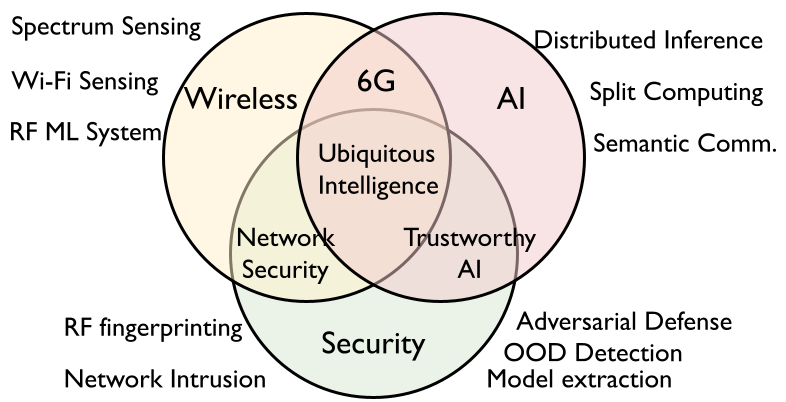
We are moving toward a future of “Ubiquitous Intelligence” where AI is woven into the wireless networks that connect our phones, cars, and everyday devices. To make this vision real, my research sits at the intersection of Artificial Intelligence and Wireless Communication, with a focus on making AI systems that operate over wireless networks simultaneously efficient, reliable and secure. More specifically, it spans three tightly coupled thrusts:
- AI-Native Wireless Networks: Applying deep learning to advance next-generation wireless technologies such as spectrum sensing, RF fingerprinting, and integrated sensing and communication.
- Efficient AI for Networked Systems: Enabling low-latency, resource-aware inference across heterogeneous edge devices through split computing, semantic communication, and multi-device model distribution.
- Security and Privacy: Developing principled defenses against attacks on edge AI systems and IoT networks, enabling reliable out-of-distribution detection, and protecting on-device models from extraction and manipulation.
AI-Native Wireless Networks
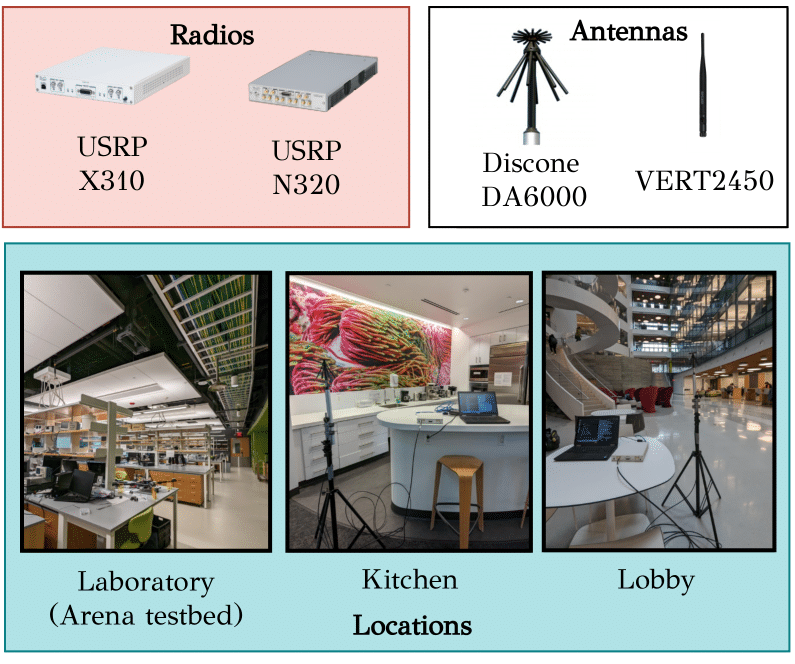
As wireless networks become more crowded and complex, an intelligent management is needed to communicate efficiently and avoid interference. In addition, beyond simply communicating, the same wireless signals can also be repurposed to sense the real world through AI, turning ordinary radio signals into a form of invisible, hardware-free sensing. My research in this thrust develops generalizable and efficient AI algorithms to advance wireless technologies.
Selected Work:
- Khandaker Foysal Haque, Milin Zhang, Francesca Meneghello, and Francesco Restuccia, “Si-FI: Learning the Beamforming Feedback for Simultaneous Multi-Subject Sensing.” Computer Networks, 2025.
- Khandaker Foysal Haque, Milin Zhang, Francesca Meneghello, and Francesco Restuccia, “BeamSense: Rethinking Wireless Sensing with MU-MIMO Wi-Fi Beamforming Feedback.” Computer Networks, 2025.
- Daniel Uvaydov*, Milin Zhang*, Clifton Paul Robinson, Salvatore D’Oro, Tommaso Melodia and Francesco Restuccia, “Stitching the Spectrum: Semantic Spectrum Segmentation with Wideband Signal Stitching.’’ INFOCOM, 2024.
- Ankit Mittal, Milin Zhang, Thomas Gourousis, Ziyue Zhang, Yunsi Fei, Marvin Onabajo, Francesco Restuccia, and Aatmesh Shrivastava, “Sub-6 GHz Energy Detection-based Fast On-Chip Analog Spectrum Sensing with Learning-driven Signal Classification.” IEEE Internet of Things Journal, 2024.
Efficient AI for Networked Systems
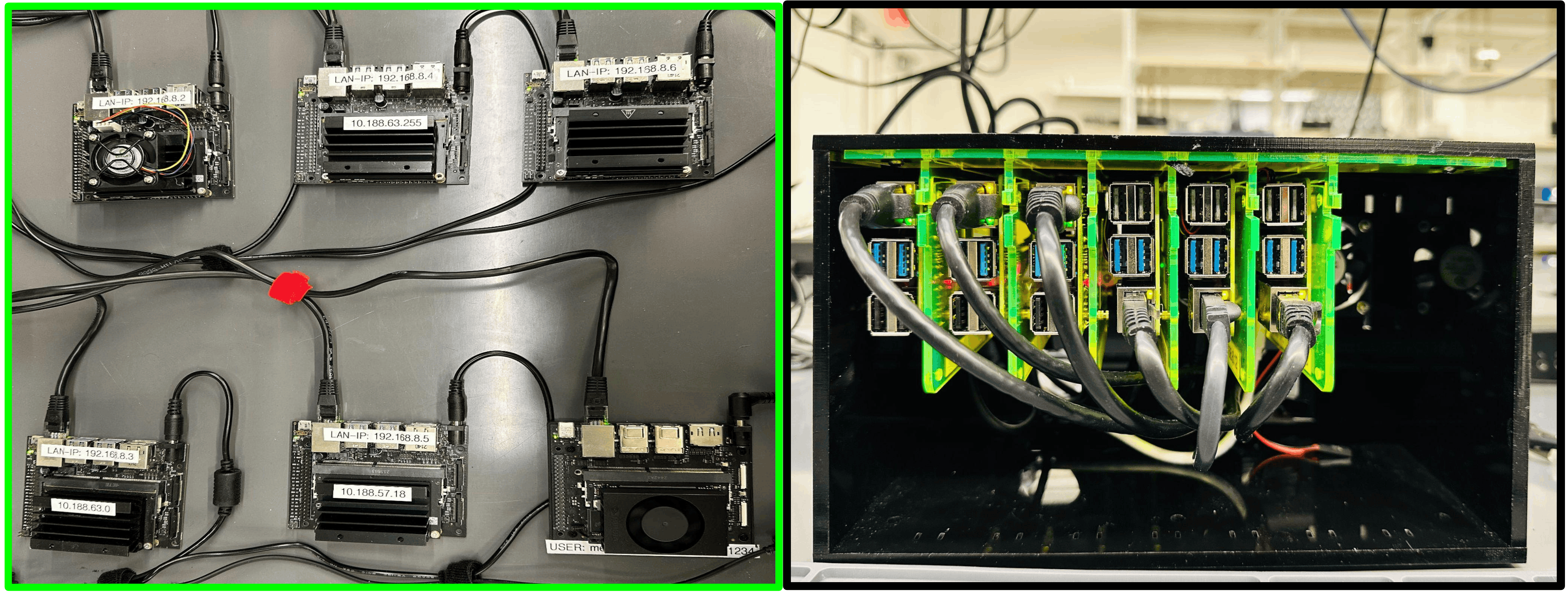
Large neural networks demand substantial memory and computations which makes direct deployment on resource-constrained devices impractical. An alternative way is to partition the large model across multiple devices, achieving a balance across computation, communication, and task-oriented performance. My research in this thrust focus on designing adaptive and low-latency collaborative intelligence in heterogeneous and dynamic edge systems.
Selected Work:
- Milin Zhang*, Tanzil B. Hassan*, Mohammad Abdi, Venkat R. Dasari and Francesco Restuccia, “MD2I: Multi-Device Model-Distributed Neural Network Inference.” Computer Network, 2026.
- Milin Zhang*, Mohammad Abdi*, Venkat R. Dasari and Francesco Restuccia, “Semantic Edge Computing and Semantic Communications in 6G Networks: A Unifying Survey and Research Challenges.” Computer Networks, 2025.
- Milin Zhang, Mohammad Abdi, Jonathan Ashdown, and Francesco Restuccia, “Adversarial Attacks to Latent Representations of Distributed Neural Networks in Split Computing.” Computer Networks, 2025.
- Milin Zhang, Mohammad Abdi, Shahriar Rifat, and Francesco Restuccia, “Resilience of Entropy Model in Distributed Neural Networks.” ECCV, 2024.
Security and Privacy
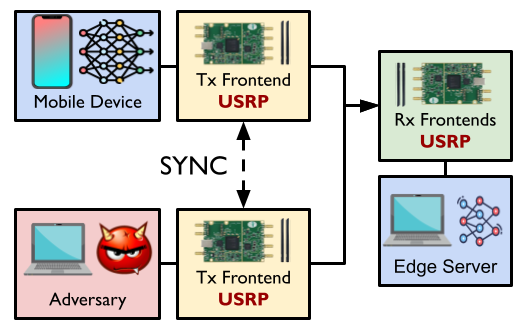
Combining AI and wireless communication does not just bring efficiency, it also inherits vulnerabilities from both sides. Wireless signals can be spoofed or intercepted, and AI models themselves can be fooled, manipulated, or reverse-engineered by adversaries. My research in this thrust develops defenses on both fronts: detecting adversaries from their radio and network level patterns, and making AI models more robust and trustworthy when faced with unexpected or malicious inputs.
Selected Work:
- Sayyed Sazzad, Shahriar Rifat, Milin Zhang, Ananthram Swami, Michael De Lucia, Nathaniel D. Bastian, and Francesco Restuccia, “Out-of-Distribution Detection in Computer Vision: A Comprehensive Survey and Research Challenges.” ACM Computing Surveys, 2026.
- Ildi Alla, Milin Zhang, Jonathan Ashdown, Valeria Loscri and Francesco Restuccia, “Finding a Needle in a (Spectrum) Haystack: Multi-Band Multi-Device Radio Fingerprinting.” Computer Networks, 2026.
- Milin Zhang, Michael De Lucia, Jonathan Ashdown, Nathaniel D. Bastian, Ananthram Swami, and Francesco Restuccia, “NI-Diff: Zero-Day and Adversarial Network Intrusion Detection with Diffusion Models.’’ MILCOM, 2025
- Milin Zhang, Michael De Lucia, Ananthram Swami, Jonathan Ashdown, Kurt Turck and Francesco Restuccia, “HyperAdv: Dynamic Defense Against Adversarial Radio Frequency Machine Learning Systems.” MILCOM, 2024.